A Sketchbook That Starts with One Leaf
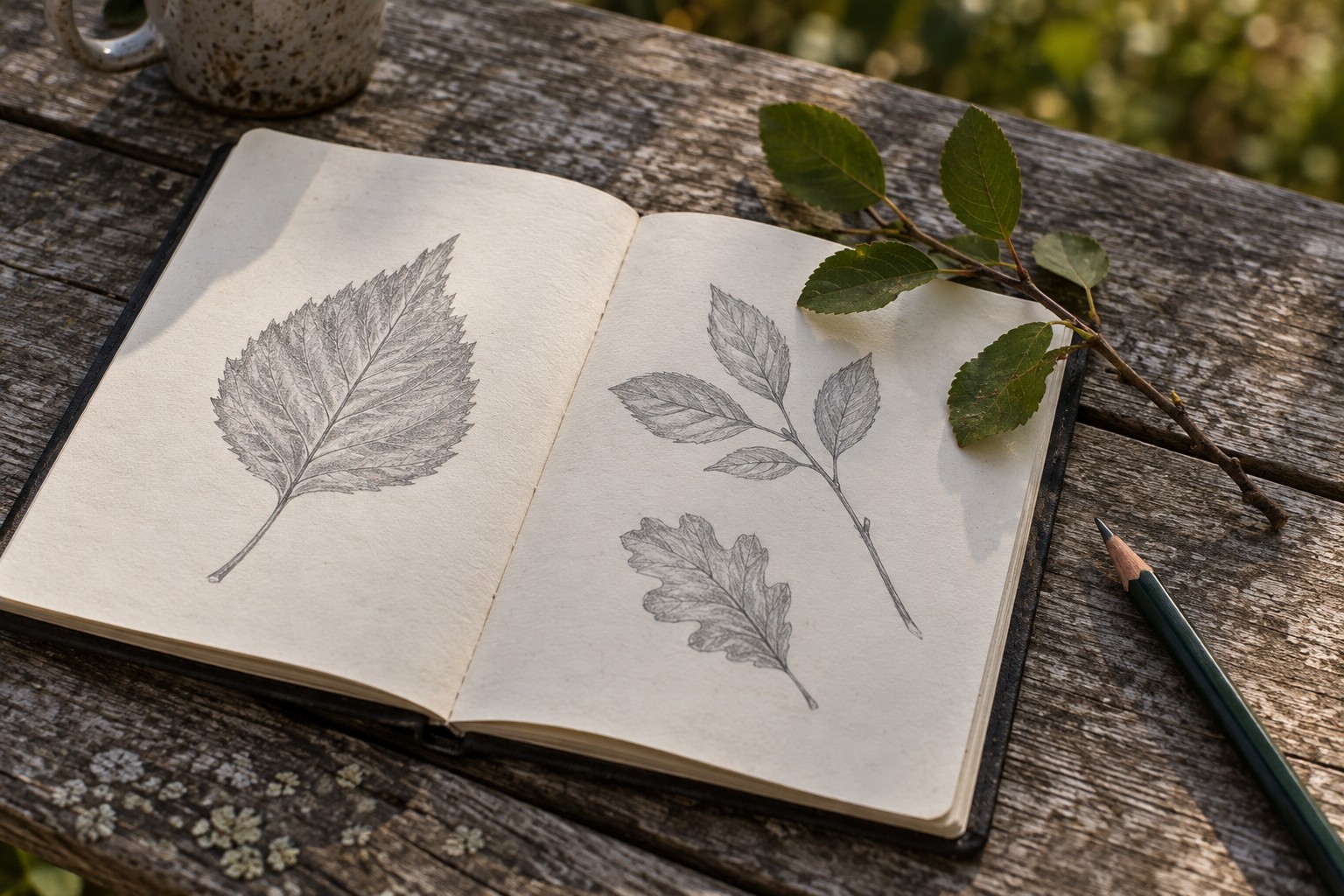
A new sketchbook can feel oddly formal. Its clean pages suggest that the first drawing should be a good one, even when the book was bought for practice. An ordinary leaf is a useful way past that hesitation. It offers a clear shape, a few interesting lines and no expectation of a finished masterpiece.
Choose a leaf already fallen from a plant, or use one lying beside a familiar path. Place it on a plain surface near a window. A single pencil and an eraser are enough. Avoid arranging an elaborate desk before beginning; the smaller the preparation, the easier it is to repeat the activity another day.
Begin with its direction
Before drawing the outline, notice how the leaf sits. Is its central vein nearly upright or leaning across the page? Make one light line to suggest that direction. Then mark the top, bottom and widest points. These simple reference marks give the outline somewhere to go and help prevent it from slowly expanding beyond the page.
Draw the two sides separately. Real leaves are rarely perfectly symmetrical, and the small differences often make a sketch more convincing. One edge may curl inward while the other lies flat. Let your line record that unevenness rather than correcting it into a tidy emblem.
Add only the veins you can clearly see. A few lines that vary in pressure can suggest more than a dense network of equally dark marks. For a curled edge, shade the narrow area beneath it lightly. Leave some of the paper untouched so the drawing has room to breathe.
Give the page a second attempt
Instead of rubbing out the first sketch until the paper becomes rough, draw the leaf again beside it. Turn it slightly or look from a lower angle. The second attempt often reveals something the first missed: a shorter stem, a broader base or a shadow that explains the fold.
A small date in the corner can help you see the notebook as a record of looking. If you want to add words, note the light, the surface or the shape you found difficult. Those observations are more useful than simply labeling a drawing good or bad.
Over time, the leaf can give way to a spoon, a folded cloth or the handle of a favorite cup. Keep the same modest scale. A sketchbook becomes welcoming through use, including the uncertain lines and unfinished pages. It does not need a polished beginning; it needs a first object and a few minutes of attention.